
How Do I Know if My Website is Good?

Most trades business owners have asked themselves this question at least once. Maybe a friend mentioned their website looked outdated. Maybe they paid someone to build it and never really thought about it again. Or maybe they’re just quietly wondering why the phone isn’t ringing as much as it should be.
The honest answer is that most websites are not as good as their owners think — not because they look bad, but because they aren’t doing the job they were built to do.
Here’s how to actually know.
The First Thing I Check When I Look at a Trades Website:
When someone asks me to look at their website, the first thing I do is copy their URL and run it through Google PageSpeed Insights. This free tool gives me an overall performance score — and it tells me a lot within seconds.
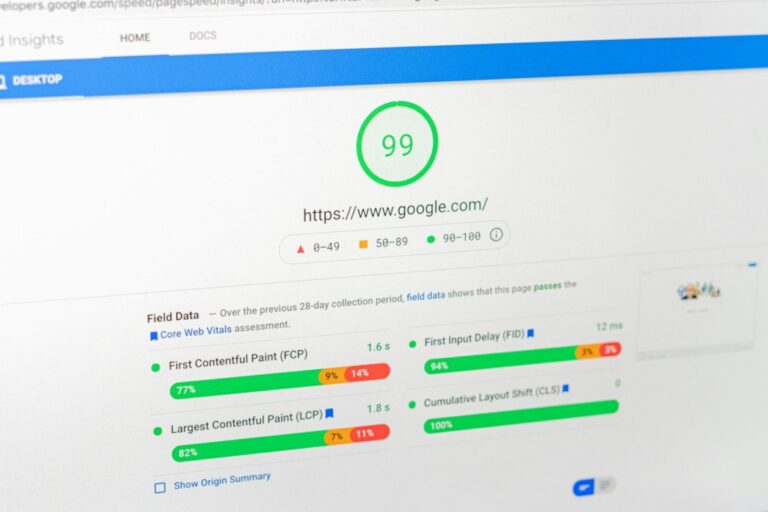
But the score alone doesn’t give me the full picture. I’m also asking:
- Are the buttons working and going where they should?
- What does the layout actually looks like on a phone?
- Is this site giving someone a reason to call, or just filling up space?
That last question is the one most people forget to ask. A Website isn’t a business card. it’s a salesperson that works 24 hours a day. if it doesn’t converting visitors into calls, it isn’t doing it’s job – no matter how nice it looks.
The Most Common Mistakes I see on Trades Websites in BC
After reviewing dozens of websites across the Fraser Valley and Lower Mainland, the same problems keep recurring.
Oversized Images That Slow Everything Down
Image over 200KB are one of the biggest silent killers of website performance. A Site that loads slowly on mobile will lose the visitors before they even see your services. Google ranks faster sites above yours in search results, so this one mistake is costing you visibility on two frontsat once.
Meta Titles and Descriptions that are wrong or missing
Most trades owners have never heard of a meta title. But Google uses it to understand what your pages is about. If it’s missing, generic, or stuffed with your business name instead of actual keywords, you’re invisible in search results.
The Copy-Paste Website Problem

This one is harder to see if you’re not looking for it. A copy-paste website is one where the content has no original voice. The homepage says something like “We are professional HVAC Specialists committed to excellence.” The contact page says something vague about being here to help. Nothing tells you who this business actually is, what area they serve, or why someone should choose them over the next result on Google.
The way I explain it to clients: If you’re going to build a house, you need a blueprint first. A website is the same thing. If you just start throwing content together without a clear structure and message, you end up with something that looks like a website but doesn’t work like one.
What a Good Website Actually Does
Looking good and working well are two completely different things – and it’s important to understand the difference.
A good-looking website might have a nice design, clean fonts and a modern layout. But if nobody can find it on Google, if the buttons lead nowhere, or if the content doesn’t answer the questions a potential customer is actually asking, it’s not a good website. It just looks like one.
The best way I can describe a working website is this: Imagine a house that isn’t the fanciest on the block, but everybody loves it. The layout makes sense. Everything works. Guests feel comfortable and know exactly where to go. People recommend it to their friends without being asked. That’s what a good trades website feels like to the person visiting it.
The goal is simple: someone lands on the page, reads what you do, sees that you serve their area, and clicks to call you. If that journey is smooth, your website is working.
A Real Example: The Plumber with the Broken Button
A while back, I came across a plumbing company’s website in the Fraser Valley. I clicked through it out of habit – checking the layout, the content, seeing how it felt to navigate.
Everything was actually pretty solid. They were using real photos of their crew and their work instead of stock images. Their services were clearly listed with their own dedicated pages. Their packages were explained properly. You could tell a real business was behind the site.
Then I clicked their contact button. it went nowhere.

When I eventually connected with the owner what I found. I said, your website is doing a lot of things right – the real photos, the service pages, the clear layout. But your contact button is broken. Every person who tried to reach you hit a dead end. That’s probably costing you one or two clients every single day.
He had no idea. The guy who built the site had never come back to check on it.
That’s the thing about a broken button – it’s invisible to the owner, but it’s the first thing a customer runs into. And they don’t call to tell you. They just leave.
The 5-Minute Self-Check You can do right now
You don’t need to hire anyone to do a basic check on your own website. Here’s what to look at:

- Run your URL through Google PageSpeed Insights: Look at your performance score. Anything below 50 on mobile is a problem that needs to be fixed.
- Check Google Search Console: Is your sitemap submitted? Is Google actually crawling and indexing your pages?
- Search your own business on Google: Are you showing up? What position are you ranking in for your main service and city?
- Click every button and form on your site: Make sure they go where they're supposed to go. Fill out your own contact form and confirm that you receive it.
- Read your own content out loud: Does it sound like a real person who runs a real business? Or does it sounds like it could belong to any company in any city in the country?
The last one catches a lot of people off guard. If your content doesn’t mention your specific services, your specific service areas, and something real about how you work, it needs to be rewritten.
Why your Website might be Invisible on Google
Here’s something a lot of trades owners don’t realize. Google has no idea who you are based on your business name alone.
Let’s say you run “Powerthunder HVAC.” Nobody is searching for “Powerthunder HVAC” unless they already know you exist. What they’re searching for is ‘heating and ventilation services in Whistler or [your city], or “HVAC Company near me”. If your website isn’t using those keywords in the right places – your page titles, your headings, your content – Google won’t connect you to those searches.
But keywords alone aren’t enough either. Your Google Business Profile needs to be set up and optimized for the areas you serve. Your business information needs to be listed consistently across other directories and citation sites. SEO isn’t one thing – it’s a combination of signals that tell Google you are a real, relevant, trustworthy business in a specific location.
If none of that is in place, your website can look great and still be completely invisible.
What About the website your nephew built?
If someone built your website for free and for a few hundred dollars, it doesn’t automatically mean it’s bad. What matters is whether it’s actually performing.
Is it indexed on Google? Is it ranking for any keywords related to your trade and your city? Are your buttons working and sending people to the right place? Does it have an FAQ section that answers the questions your customers actually ask?
If the answer to those questions is no, it doesn’t matter what it costs or who built it. It’s not working.
A website that looks fine but sends button clicks to a random third-party page, has no FAQ, and was never submitted to Google Search Console isn’t a business asset. It’s a placeholder.

The Bigger Truth most trades owners miss!
About 95% of trade business owners I talk to believe word-of-mouth is enough, and I understand why – referrals are powerful, they’re warm leads, and they’ve kept a lot of businesses running for years.
But word of mouth has a ceiling. There are only so many people in your network. There are only so many referrals that can come through at any given time.
The internet doesn’t have that ceiling.
Not everyone has a desktop computer, but everyone has a smartphone and everyone knows how to Google something when they have a problem. When a pipe burst at 10 pm, that homeowner isn’t calling their friend for a referral. They’re searching for a plumber near them and calling whoever shows up first.
If your website isn’t there when that search happens, you don’t exist to that customer.
Everything is moving digital. The trades owners who understand that their website is not just a formality – but an actual revenue tool – are the ones who are going to be fully booked while their competitors are still waiting on referrals.
So, is your Website Good?
It’s good if people can find it on Google. It’s good if it loads fast on a phone. It’s good if the buttons work and the forms go through. It’s good if the content sounds like a real person who does real work in a real city, and its good if people who land on it actually pick up the phone and call.
If you’re not sure, start with a PageSpeed score and a Google search of your own services. That will tell you more in five minutes than most people learn in years.
And if you want a second set of eyes on it, that’s exactly what I do.